Operation Benefactor
An Officer and a SpyOperation Benefactor was Georges Picquart’s unauthorized-at-first, subsequently approved surveillance operation against Esterhazy, and the first sustained effort in this account to turn suspicions about him into observable evidence. Its watchers established that Esterhazy visited the German Embassy in Paris, but the operation’s poor intelligence yield and its growing political risk made it a point of conflict with the military hierarchy. Its name captured the contrast at its center: a nickname associated with Esterhazy’s private spending became the code for an investigation that threatened the official handling of the Dreyfus case.
Origins and Objective
Reports gathered by Desvernine described Esterhazy’s relationship with a woman living in an apartment at 49, Rue de Douai. The lease was in Esterhazy’s name, and he reportedly visited her when he was in Paris. People around her called him the Benefactor. Desvernine also reported that Esterhazy was pursuing several ways to support his expenses, including an attempt to join the board of a British company in London. These details suggested financial pressures and a connection worth examining; they did not by themselves establish espionage.
Picquart adopted Benefactor as the code name for Esterhazy and opened an active case file. He used money from a special fund in his safe to recruit Ducasse, advancing six hundred francs for an apartment deposit and four hundred francs as two weeks’ pay. Ducasse was instructed to keep the work secret and to avoid being seen with Picquart. Desvernine, using the assumed identity Houdin, briefed him on his role after he had rented the premises. The operation thus began as a concealed, deliberately compartmentalized undertaking, with Picquart withholding Esterhazy’s name even from the first memorandum he later submitted to General Gonse.
The Apartment Opposite the Embassy
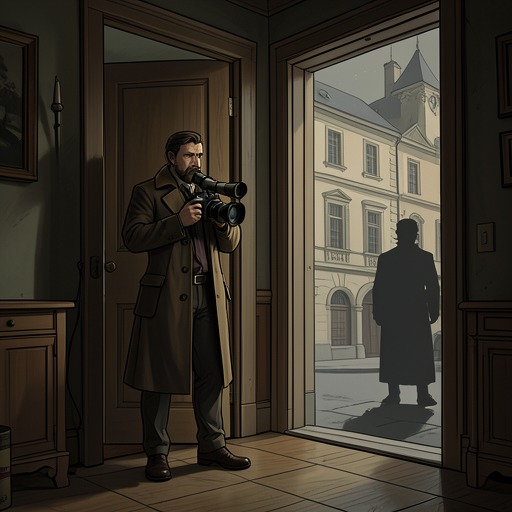
The surveillance post was established at 101, Rue de Lille, directly opposite the German Embassy in Paris, housed at 78, Hôtel de Beauharnais. From the upper-floor apartment, agents could observe the embassy entrance across the street. Its three shuttered windows were fitted with narrow observation holes. One held a modified Kodak camera, purchased in London for eighteen pounds sterling and mounted on a tripod with a film-roll canister and variable lenses; another held a telescope. At a desk by the third opening, Ducasse recorded the times visitors entered and left.
Photographs of people of interest were pinned to the walls, including Esterhazy, Maximilian von Schwartzkoppen, Count Münster, the German ambassador, and Alessandro Panizzardi. During Picquart’s first inspection, the watchers identified Maximilian von Schwartzkoppen and Alessandro Panizzardi among men observed outside the embassy. The scene demonstrated the post’s practical value: the agents could identify some of the figures associated with the diplomatic premises and maintain a record of their movements, even when they could not determine the purpose of every visit.
The operation required General Gonse’s authority for a more intrusive method. Picquart sought approval for installing speaking tubes but submitted a memorandum that did not name Esterhazy, because he still wanted to keep that part of the investigation to himself. Gonse noticed that the apartment had already been rented and equipped before approval was requested. After considering the plan, he signed the memorandum and allowed Picquart to proceed, while making Picquart personally responsible if the operation went wrong. The permission was therefore real but conditional, and did not amount to the General Staff’s full knowledge of Picquart’s target or conclusions.
Listening Tubes and Photographic Evidence
The agents planned to install two tubes through the chimney flues, one intended to pick up conversations near the ground-floor fireplace and another in a bedroom. The work could be done only when the apartment below was empty, usually at night. Desvernine had to bring in the equipment and tools without attracting attention; the agents proceeded slowly, because a misplaced blow could dislodge soot into the fireplaces and alert the occupants. Ducasse also faced questions from the couple living upstairs about the noise and his daily routine. The concealment placed pressure on the small team, and Desvernine reported that Ducasse had begun drinking heavily.
Rather than break into the Germans’ apartment, Picquart proposed disguising two men as chimney sweeps. In mid-May, a patriotic sweep known to Desvernine gained entry while the occupants were preparing to eat. He made repeated trips between the ground floor and the first-floor apartment, lowering the tubes while pretending to clean the flues, and secured both in place. The method solved the access problem without a forced entry. The listening devices gave the agents the general sense of conversations when a speaker was close to a fireplace, but did not provide consistently intelligible transcripts.
The camera produced a more definite result. An early photograph, taken in bright May sunlight, was blurred enough that identifying its subject required prolonged examination. Picquart nevertheless recognized Esterhazy by his distinctive round eyes and moustache as he left the embassy. A later image was markedly clearer: Esterhazy, wearing a grey bowler, was shown coming through the embassy gates, with his face visible without magnification. For Picquart, this was more than another recorded visit; the photograph was a tangible link between the suspected officer and the diplomatic premises.
Briefing and Institutional Resistance
The operation ran for months before Picquart briefed Major Henry and Captain Lauth on 3 August, three days before a scheduled meeting in Basel. He explained the investigation in stages, bringing together the petit bleu addressed to Esterhazy, a draft letter from Maximilian von Schwartzkoppen about poor value from the house of R, his earlier visit to Rouen and conversation with Albert Curé, Desvernine’s reports on Esterhazy’s debts and gambling, and photographs of two embassy visits. The apartment and its surveillance equipment surprised the officers. Picquart presented the material as the culmination of an investigation that had begun to produce results, rather than as an isolated photographic discovery.
When Picquart later laid out the evidence for General Gonse, he included the petit bleu, the surveillance photographs, and the secret file. He also acknowledged that the file did not establish Alfred Dreyfus’s guilt and would not withstand competent cross-examination. Gonse’s answer sharply separated the two questions: Picquart could investigate Esterhazy, but was told to leave the bordereau out of it. That restriction preserved a narrow opening for surveillance while preventing the evidence from challenging the central basis of Dreyfus’s conviction.
As the controversy widened, Gonse’s approach hardened. He argued that reopening the original investigation would reopen wounds and risk tearing the country apart, and urged Picquart to shut the matter down. He eventually issued a formal order forbidding further investigation of anything connected with the Dreyfus case and forbidding disclosure to anyone not authorized to receive it. Picquart left without answering. During a later administrative change, Gonse took the file marked D and arranged for Major Henry to send the Agent Auguste material directly to him, transferring control of an important source away from Picquart as he prepared to leave on an inspection tour.
Yield and Significance
Operation Benefactor generated a substantial volume of material, but little of it was useful. By July, Picquart had spent thousands from the secret fund bequeathed by Jean Sandherr, risked a diplomatic crisis, and kept a potential traitor’s identity from his superiors. The accumulated output consisted largely of blurred photographs, visitor descriptions too uncertain to identify their subjects, and fragmentary transcripts. The clearest result remained the image of Esterhazy at the embassy, later reinforced by a sharp second photograph. The operation could establish presence and association more readily than it could explain what had been said or exchanged.
That limit mattered because surveillance did not operate in a neutral space. Picquart’s evidence pointed toward Esterhazy, but his superiors controlled whether it could be connected to the bordereau and to the conviction of Alfred Dreyfus. Gonse’s approval of the technical operation, his restriction on how its findings could be used, and his eventual order to stop the investigation mark a progression from conditional permission to institutional containment. The surveillance post could watch the embassy; it could not compel the General Staff to follow what its images implied. In that contrast, Operation Benefactor becomes both an intelligence effort and a measure of the limits imposed on evidence by the institution that gathered it.